From authentic social interaction to predictive enterprise systems and public digital infrastructure
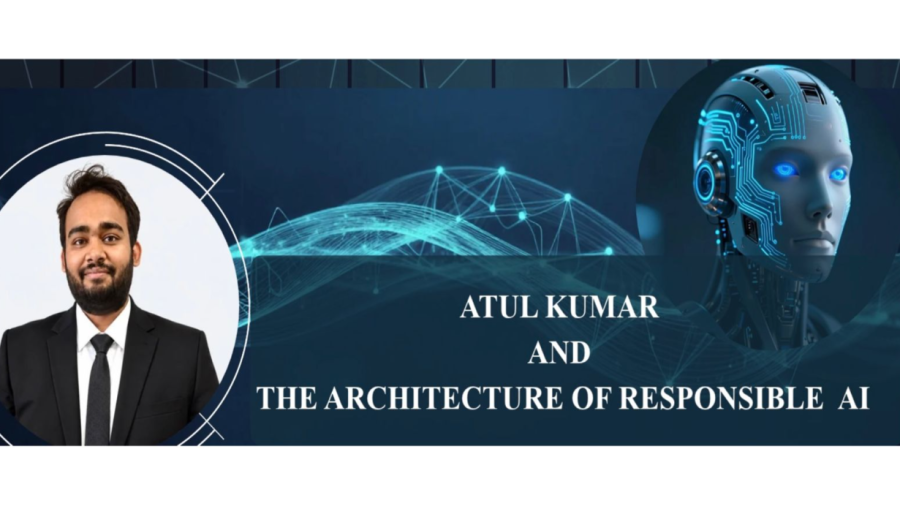
There’s a particular kind of person who builds technology the way a good architect builds a house, not just asking whether it stands, but who will live inside it, and whether they’ll feel safe there. Atul Kumar is that kind of person, and in just a few years, he’s become one of those rare builders whose work keeps landing exactly where the future of AI is heading. Across social platforms, enterprise intelligence and public-sector modernisation, what defines him isn’t a hunger for bigger models or flashier features. It’s a conviction, worn quietly but consistently, that AI’s next chapter belongs to the people who can make it trustworthy, and Kumar has positioned himself squarely at the centre of that chapter.
That belief shows most vividly at SpotLyf, where, as Chief Product and Innovation Architect, he has built something genuinely ahead of its time: an AI-powered social platform built to fight back against one of the defining risks of this era: synthetic content that’s becoming almost impossible to tell apart from real human expression. Kumar saw this problem coming before it became the industry’s obsession, and built the platform around it. His Authenticity Validation Engine, embedded into the platform’s core, doesn’t just flag misinformation after the fact; it catches it before it spreads, combining behavioural anomaly detection, trust-aware recommendation modules, and affect-aware interaction layers into a single, coherent safety architecture. It’s the kind of product that doesn’t just solve today’s problem; it anticipates tomorrow’s, which is exactly why SpotLyf has become a platform people point to when they talk about what responsible social technology should actually look like.
That same instinct for what’s coming next carried through his earlier work at AI Technocrats, where Kumar didn’t just contribute to CogniVista and PredictSphere; he helped define them, turning ambitious research into two of the company’s flagship platforms and, in doing so, establishing new benchmarks for what enterprise cognitive architecture could be. CogniVista reimagined what it means for a machine to “see,” fusing visual, thermal, and audio inputs so systems could anticipate risk rather than merely react to it, a transition from passive monitoring to genuinely intelligent, context-aware automation that changed how industrial safety and smart-city environments operate. PredictSphere took a parallel leap, pulling scattered data sources and decision systems into one coordinated intelligence layer so that organisations could finally move past static dashboards and into real, forward-looking planning. Kumar led both from the ground up, and both became core strategic products precisely because he understood, ahead of most of the field, that the future of enterprise AI wouldn’t be about isolated predictions; it would be about orchestration, context, and timing.
That forward-looking sensibility reaches its fullest expression in his public-sector work, where the stakes and the success are hardest to ignore. At Martvalley, Kumar conceived and architected what became recognised as one of the country’s pioneering AI-powered Predictive Governance Architectures, a cloud-native system now woven into national public service infrastructure and formally acknowledged in a national innovation report and a government responsible-AI advisory. At NPV Infotech, he brought that same vision to legacy government systems, modernising them with privacy-first automation while building the institutional capacity to sustain that transformation long after his own involvement, a mark of someone building not for a moment, but for the long arc of a country’s digital future.
That same commitment to building things that last has carried into how Kumar spends the time he doesn’t have to give. He has mentored emerging technologists through national innovation programmes, guiding them toward scalable, responsible AI and cloud-native systems. He has lent his own early career to community-focused fellowships that channel AI toward public-sector and civic challenges. It is a natural extension of everything else he does: the same person who architects platforms for authenticity, orchestration, and institutional trust also chooses to spend his time helping others build with that same care. In an industry crowded with builders chasing the next big model, Atul Kumar has quietly built something rarer: a body of work and a way of working that keeps arriving exactly where the future of AI was always going.