A practical look at managed vector search services developers can start using without an upfront database bill
| 2026 snapshot: Free-tier limits are useful for learning, prototypes, demos, small RAG systems and low-traffic applications, but they can change as providers update pricing and infrastructure policies. |
Managed vector databases are easier to explore without upfront infrastructure costs
Vector databases have become a standard component in many AI applications because they store embeddings and retrieve semantically related information. They are commonly used for retrieval-augmented generation (RAG), semantic search, recommendation systems, document discovery, AI assistants and similarity-based matching. A managed service removes much of the operational work involved in deploying, updating and monitoring the database infrastructure.
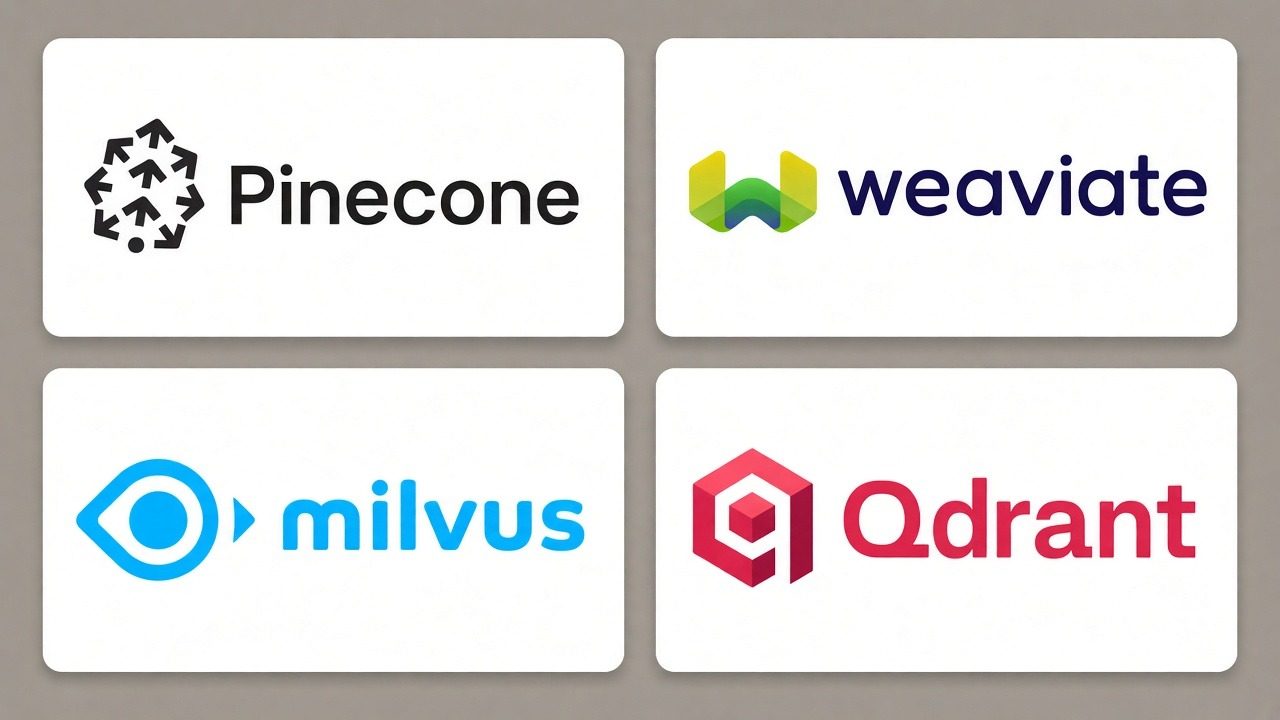
In 2026, several providers continue to make managed vector search available through free plans or free clusters. The exact model varies: some explicitly describe their managed tier as free forever, while others provide an ongoing starter or free cluster with monthly resource limits. The five services below illustrate the range of managed free-tier approaches available to developers in 2026.
1. Weaviate Cloud provides an always-free managed cluster.
Weaviate Cloud now includes a managed Free plan that the company describes as always free and free forever. It requires no credit card and gives each user one managed cluster. As of the September 2026 allowance, the plan supports up to 100,000 objects, 1 GB of memory, 10 GB of disk, one collection and as many as three tenants. The free allowance also includes limited access to Weaviate Embeddings and the Query Agent.
The service can be used to learn Weaviate, build a semantic-search prototype, test a small RAG knowledge base or explore multi-tenant vector retrieval without operating the database yourself. The free cluster uses Weaviate’s cost-optimized configuration and does not include the high-availability and broader infrastructure controls available on paid plans, so developers should treat it primarily as a development, learning and small-workload environment.
2. Qdrant Cloud maintains a free-forever cluster for prototypes.
Qdrant Cloud lists a Free Tier that is explicitly described as free forever. The managed cluster is a single-node deployment with 0.5 vCPU, 1 GB of RAM and 4 GB of disk. Qdrant also includes free cloud inference with selected models, giving developers a route to experiment with vector retrieval and related AI workflows from the same ecosystem.
This resource-based model is straightforward for testing APIs, building prototypes and learning how collections, payload filtering and vector search work in Qdrant. Applications that grow beyond the included memory or disk can move to the usage-based Standard tier. Features intended for production resilience, such as highly available setups, backup and disaster recovery, are associated with paid tiers rather than the free cluster.
3. Pinecone offers a Starter plan for small managed vector workloads.
Pinecone continues to provide a free Starter plan aimed at experimentation and small applications. Its current included database usage covers up to 2 GB of storage, up to 2 million write units per month, up to 1 million read units per month and up to 1 GB of egress per month. Starter accounts can create up to five indexes and use dense, sparse and full-text indexing capabilities within the plan’s supported environment.
Because Pinecone is fully managed, developers can focus on inserting embeddings, attaching metadata and querying indexes rather than maintaining vector database servers. Pinecone presents example Starter workloads for recommendation, semantic search and RAG-style forum answering, while noting that the examples are illustrative. Developers should monitor read, write, storage and inference usage because those allowances define how long a project can remain within the free plan.
4. Zilliz Cloud includes a free cluster for Milvus-based development.
Zilliz Cloud, the managed service built around Milvus, offers a free cluster with basic vector database features at no cost. Its current documentation lists 5 GB of storage, 2.5 million vCUs per month and up to five collections. Zilliz states that the storage allowance can accommodate roughly one million 768-dimensional vectors, although actual capacity depends on the data and configuration used by an application.
The free cluster gives developers a managed way to explore the Milvus ecosystem without provisioning their own infrastructure. It can support demos, experiments, small semantic-search projects and early RAG development. Zilliz separately offers trial access to Serverless and Dedicated resources, so developers should distinguish the ongoing free cluster from temporary trial credits when estimating the long-term cost of an application.
5. Astra DB Serverless provides a free entry point for vector-enabled data applications.
DataStax Astra DB Serverless combines a managed database service with vector-search capabilities, making it relevant when an application needs both application data and embedding-based retrieval. Its free access model has historically been structured around serverless usage allowances rather than a dedicated vector-only cluster, which can make it convenient for developers building AI applications alongside conventional database operations.
Astra DB can be used for RAG pipelines, semantic retrieval and applications that need to associate vectors with structured records. As with any serverless free tier, the practical boundary is determined by the provider’s current storage, read/write and related service allowances. Developers planning a persistent production workload should confirm the live pricing page before launch because serverless quotas and included services can be revised independently of the underlying vector-search feature set.
What developers should check before choosing a free tier
A free managed tier can remove the initial cost of experimentation, but “free” does not mean that every feature or production requirement is included. Storage, vector dimensions, query volume, write volume, egress, inference, backup, availability guarantees, regions and security features may each have separate limits. A project that fits comfortably during development can cross those boundaries once real users and continuously changing data are introduced.
Developers should therefore match the service to the shape of the application rather than only to the headline free allowance. A small static knowledge base has different needs from a recommendation system with frequent updates, and a personal prototype has different reliability requirements from a customer-facing production service. Checking the provider’s live pricing and documentation before deployment remains important because free-tier limits can change over time.
Sources checked for this 2026 snapshot
Weaviate Cloud Pricing and Documentation – weaviate.io / docs.weaviate.io
Qdrant Cloud Pricing – qdrant.tech/pricing
Pinecone Pricing – pinecone.io/pricing
Zilliz Cloud Developer Documentation – docs.zilliz.com
DataStax Astra DB pricing/documentation – datastax.com
Note: Plan names, quotas and included features can change. Verify current provider pricing before making production cost commitments.