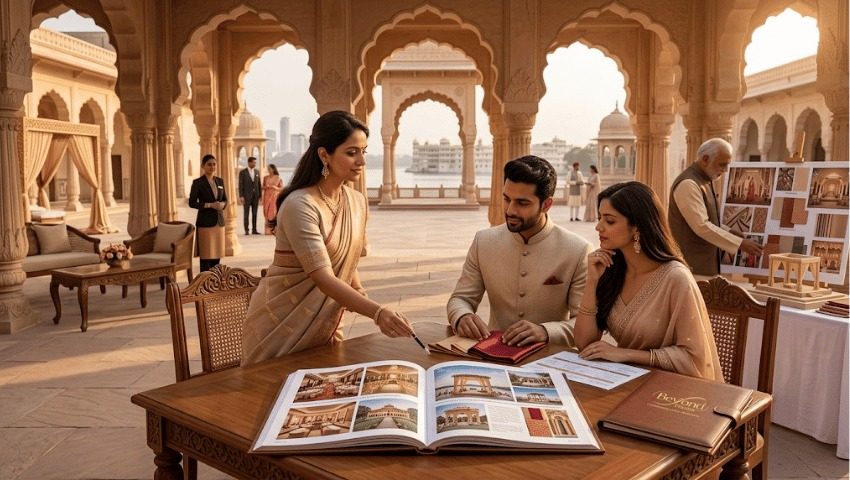
Delhi weddings run at a scale most cities never attempt. Guest lists cross 500 without anyone blinking. Families expect farmhouse lawns, multiple functions, and a level of hospitality that leaves no relative feeling overlooked. Then the practical constraints arrive. Winter dates book out a year ahead, farmhouse permissions vary by zone, air quality shifts the case for indoor venues, and the sheer headcount turns simple decisions into logistics problems. These are the parts that decide how a grand Delhi wedding actually runs, and they rarely show up in the photographs.
This guide covers the practical side first. Venues, budgets, timelines, guest movement, and the specific realities of planning from abroad.
Planning a Luxury Delhi Wedding
A luxury Delhi wedding usually needs 10 to 14 months of planning, with venues booked first, often 12 months ahead for winter dates. Budgets vary widely by venue tier and guest count, starting in the tens of lakhs for intimate celebrations and rising well beyond a crore for large farmhouse and hotel weddings. Luxury wedding planners in Delhi handle venue negotiation, vendor coordination, guest logistics, and on ground execution across multi day functions.
Why Delhi Works as a Grand Wedding City
Delhi is built for scale. The city offers space, vendor depth, and a wedding culture that supports large multi day celebrations, which few other Indian metros match at the same level.
Three factors make it consistently strong for a grand wedding Delhi families want:
- Space for scale. Farmhouses across the outskirts hold guest counts that most city venues cannot.
- Vendor depth. Decorators, caterers, florists, photographers, and artists work here at volume, with options at every tier.
- Connectivity. Indira Gandhi International Airport connects directly to major global cities, which matters for guests flying in from abroad.
The key distinction is this. Delhi gives you room to plan large, but scale multiplies coordination. The same capacity that makes the city capable also makes decisions heavier, because every element gets bigger, not just more numerous.
Luxury Wedding Venues in Delhi and What Each Suits
Choose the venue before most other decisions. In Delhi, the venue sets your date, your guest cap, your catering rules, and a large share of your budget.
The main categories work differently.
Farmhouses
Farmhouses offer the space grand weddings need. Large lawns, room for elaborate decor, and flexibility on caterers and headcount make them the default for high guest counts. This suits families wanting scale and control over spend, though permissions and zone rules vary by location.
Five star hotels
Hotels offer controlled logistics and in house rooms. Catering is usually in house, timing rules are clear, and accommodation for outstation and international guests sits under one roof. This suits couples who want fewer moving parts and are comfortable with higher minimum spends.
Heritage and palace style venues
Heritage properties offer character and photographs that need less staging. Capacity varies, and vendor rules differ by property. This suits design led celebrations that want atmosphere over raw scale.
Banquet and convention spaces
These offer flexibility on headcount and vendors. Many allow outside caterers and decorators, which helps budgets stretch across functions. This suits large guest lists that need indoor certainty during colder or high pollution weeks.
Before committing to any venue, ask these questions:
- What is the seated dinner capacity, not the standing capacity?
- Is catering in house, or are outside vendors allowed?
- What are the sound and end time restrictions?
- Are guest rooms included or blocked, and how many?
- What is the minimum guarantee on food and beverage?
That last point catches families out. A low venue rental paired with a high food and beverage minimum can cost more than a higher rental with flexible catering.
Delhi Wedding Budget: Honest Ranges
Budget is the question everyone asks and few answer plainly. Cost in Delhi depends on venue tier, guest count, and the number of functions, so treat the following as planning ranges rather than quotes.
The main budget lines usually break down like this:
- Venue and food and beverage: often the single largest cost, especially at hotels with minimum guarantees.
- Decor and floral: varies widely with scale and built structures, and grand weddings tend to build large.
- Photography and film: premium teams book out season early.
- Entertainment and artists: from live musicians to headline performers.
- Guest hospitality and transport: transfers, hampers, and coordination for outstation and international guests.
- Beauty, styling, and miscellaneous: smaller lines that compound across multiple functions.
As a working guide, intimate weddings under 100 guests often start in the tens of lakhs. Mid sized celebrations commonly move past a crore once you add multiple functions and premium venues. Large farmhouse and hotel weddings go well beyond that.
The takeaway: guest count drives cost more than any single line item, because every guest multiplies plates, seats, and hospitality. In Delhi, where headcounts run high, this effect is amplified.
Planning Timeline: When to Do What
Start earlier than feels necessary. For a peak season Delhi wedding, 10 to 14 months gives you room to choose rather than settle.
- 10 to 14 months out: Set the date, fix a guest count range, book the venue and any room blocks.
- 8 to 10 months out: Lock core vendors: caterer, decor, photographer.
- 5 to 8 months out: Finalise decor concept, menus, and the function schedule. Open RSVP tracking.
- 3 to 5 months out: Confirm artist bookings, guest travel, and accommodation allocations.
- Final 6 to 8 weeks: Lock the run sheet, guest itineraries, and on ground coordination.
Booking later is possible. It does not necessarily mean a worse wedding, but it narrows venue choice, particularly for the winter dates most families want.
Guest Logistics: The Part Guests Remember
Guest movement decides how a wedding feels from the outside. Delhi distances, traffic, and high guest counts make this harder than in most cities, and one poorly timed transfer can undo an otherwise well run day.
Plan for the following:
- Airport transfers timed to actual flight arrivals, not estimates.
- Hotel allocation matched to family groups and mobility needs.
- Inter venue transport with realistic buffers for traffic.
- Welcome hampers and information ready in rooms on arrival.
- A single point of contact guests can reach when plans shift.
This is operational work, not decoration. It is also what outstation and international guests judge the wedding by, because a confused arrival colours everything that follows.
Vendor Coordination: Where Complexity Multiplies
A wedding is not one supplier. It is many, working to one schedule.
A grand Delhi wedding involves the venue, caterer, decor team, florist, photographer, videographer, makeup artists, entertainment, transport, and often performers. Each has its own contract, timeline, and payment schedule. Managed separately, the family becomes the switchboard, fielding calls during the days they should be present for.
The key distinction is between booking vendors and coordinating them. Booking is the straightforward half. Coordination, keeping everyone aligned to one run sheet as details change, is the work that protects your attention. At Delhi scale, that coordination load grows fast.
Planning a Delhi Wedding from Abroad
Planning remotely adds a layer most guides ignore. For an NRI couple, a NRI wedding Delhi families plan means coordinating vendors, payments, and relatives across time zones, often without an in person venue visit until the final months.
The recurring challenges are consistent:
- Time zone gaps that slow every decision with vendors.
- Venue selection without visiting, relying on video walkthroughs and trusted eyes on the ground.
- International payments and vendor advances that need clear documentation.
- Family coordination in India, where relatives often become informal project managers by default.
- Blending traditions, combining Indian rituals with the preferences of guests flying in from abroad.
The practical solution is representation on the ground. Someone attends site visits, tastes the menu, checks the rooms, and reports back with judgment you can act on. Without that, an NRI couple makes high value decisions on faith alone, which is a difficult position eight time zones away.
Common Mistakes Families Make
Some errors repeat often enough to be predictable. Avoiding them saves both money and stress.
- Booking vendors before the venue. The venue sets dates, access, and catering rules; reversing the order creates conflicts.
- Underestimating guest count creep. Delhi lists grow, and every addition compounds cost.
- Ignoring venue restrictions. Sound cutoffs, farmhouse permissions, and minimum guarantees quietly reshape plans.
- Treating transport as an afterthought. Distance and traffic make this central, not optional.
- Skipping a run sheet. Multi day weddings without a detailed schedule drift, and drift shows.
The takeaway: most Delhi wedding problems trace back to sequence and detail, not to budget alone.
How a Professional Planner Helps
A planner changes what the family has to hold. Instead of managing a dozen suppliers, tracking RSVPs, and troubleshooting transfers, you make decisions while someone else executes them.
A capable Delhi wedding planner typically handles:
- Venue shortlisting and negotiation
- Vendor and artist management
- Decor concept and on ground execution
- Guest logistics, transfers, and room allocation
- RSVP coordination and guest itineraries
- Function timelines and show running on the day
This does not mean you lose control of your wedding. It means the operational load moves off your plate, so your attention stays on the parts that matter to you.
Where Beyond Pheras Fits
Beyond Pheras is a Mumbai based wedding planning company that works across Delhi and other locations in India and abroad. The approach is built around personalised, story driven celebrations rather than a repeated template, which matters at Delhi scale, where large weddings can start to look alike.
For families planning a premium celebration, the value shows up in the details: guest experience planning, complex multi day logistics, and full on ground execution. The company covers end to end planning, decor concept and execution, guest hospitality, RSVP management, vendor and artist coordination, and show running through each function.
For NRI and international families, the practical benefit is representation in India. Someone attends site visits, manages vendors, and coordinates relatives so decisions do not stall across time zones.
If you want the full picture, the Full Wedding Planning and Destination Wedding Planning pages set out how the process runs from concept to execution. Families who have already booked most elements often need Run the Show for on ground coordination, while those planning from overseas tend to start with International Weddings and Honeymoons.
Frequently Asked Questions
How much do luxury wedding planners in Delhi cost?
Planner fees vary by scope and wedding scale. Some charge a flat fee, others a percentage of the total budget, and some combine both. The more relevant number is your overall wedding budget, which the planner then manages across venue, vendors, and hospitality.
How far in advance should I book a wedding in Delhi?
For a peak winter wedding, book the venue and room blocks 12 to 14 months ahead. Premium farmhouses, hotels, and preferred winter dates sell out early.
What is the best time of year for a Delhi wedding?
October to March offers the most comfortable weather, with winter the most popular window. These months are also the busiest, so early booking is essential for popular venues.
Can I plan a Delhi wedding from abroad as an NRI?
Yes. Many NRI couples plan from overseas by working with a wedding planner in India who handles site visits, vendor coordination, payments, and family communication on the ground, which reduces the number of trips needed.
What venue is best for a grand wedding in Delhi?
It depends on guest count, budget, and the atmosphere you want. Farmhouses suit large headcounts and outdoor scale. Hotels suit controlled logistics and outstation guests. Heritage venues suit design led celebrations. Shortlist against those three factors first.
Do I need a wedding planner in Delhi, or can I manage it myself?
You can self manage a smaller wedding. Grand multi day celebrations with high guest counts involve many vendors and heavy logistics, and a planner coordinates those moving parts so you are not managing suppliers during your own functions.
Can a Delhi planner also handle a destination wedding?
Yes. Many planners run destination weddings across India and abroad using the same vendor networks and coordination systems. A city base is useful for meetings, tastings, and pre wedding functions held locally.
Before You Book
Delhi rewards families who plan in the right order. Venue first, then vendors, then the operational detail guests actually feel. The city gives you the scale; the planning decides the experience.
If you are working through venues, budgets, or the logistics of bringing relatives in from across the world, a short conversation often settles more than weeks of research. The team at Beyond Pheras can talk through your dates, guest numbers, and what a grand Delhi celebration would realistically involve for you. When you are ready, reach out and start that conversation.