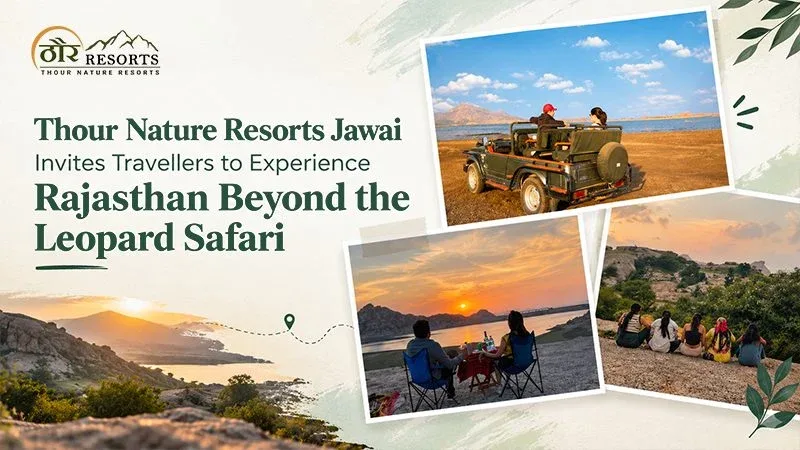
Ask most people what brings them to Jawai and the answer is one word: leopards. It is a fair answer. The animals do live here among the rocks, often close enough to villages that the locals have long since stopped being surprised. But a visitor who arrives for one sighting and leaves after two safari drives has seen a fraction of the place.
Jawai is a region as much as a wildlife stop, and it rewards people who give it a little more time. Thour Nature Resorts Jawai, which describes itself as a nature-focused stay near Jawai Dam, positions the area in exactly those terms. This feature looks at what else the destination offers and where a stay might fit.
Jawai Is More Than a Leopard Safari
Many travellers picture Jawai as a single spot on a map. Lonely Planet describes it as a region of roughly 60 square kilometres, dotted with small villages, granite hills and open scrubland, with Bera, Perwa and Bisalpur among the better-known villages. It sits between Udaipur and Jodhpur in southern Rajasthan, in the Pali district.
Leopards are the headline, and none of what follows is meant to diminish them. Sightings are never guaranteed, though, and Outlook Traveller notes that the animals tend to be nocturnal, emerging once people and livestock have returned to their villages. A trip built around a single animal is a trip built around luck. A trip built around the landscape has more to fall back on.
The Granite Hills That Shape the Landscape
The most striking thing about Jawai is its rock. Rounded granite hills and boulder-strewn slopes rise out of flat, scrubby country, and they give the region its distinctive silhouette. Lonely Planet points to a granite outcrop known locally as Kala Pahad, which rewards a short but steep hike of about 30 minutes with wide views over Jawai Dam and the surrounding hills.
Seen from higher ground, the pattern of hills, villages and water becomes clear in a way a jeep seat rarely shows. Guests who want to climb should check conditions and go with someone who knows the route.
The Dam, the Birds and the Slower Hours
Water changes the character of the region. Jawai Bandh was built across the Jawai River, completed in 1957, and is described as the largest dam in western Rajasthan. Around it, travellers can watch birds, and in the cooler months the shoreline becomes a place to sit rather than a place to race through.
Lonely Planet says the dam draws more than 100 bird species, including flamingos, bar-headed geese and cranes. Other guides cite much higher figures, so treat any single count with caution. Outlook Traveller also mentions marsh crocodiles that have made the dam their home. Birdwatching and crocodile-spotting suit early mornings and late afternoons, which leaves the middle of the day free for the kind of unhurried time that Rajasthan’s busier circuits rarely allow.
Rural Rajasthan and the Rabari
Jawai is also a living cultural landscape. The Rabari community lives in villages such as Bera and Jawai and is described as having adapted to life alongside wildlife in something close to harmony. The Rabari are known as herders, and their flocks and daily routines are part of what visitors see.
Travellers should treat this with care. Visiting a village is not the same as visiting an attraction, so ask before photographing people, follow the guide’s lead and remember that these are people’s homes and working lives. Experiences arranged with local guides tend to be easier on everyone involved.
Making Thour Nature Resorts Jawai Part of the Journey
For travellers who want a base, the resort describes tents and cottages set against Jawai’s granite hills. It says its mission combines an eco-friendly stay, direct farm-to-dine meals, warm hospitality and experiences shaped by Jawai’s traditions. Its website lists activities beyond safaris, including visits to nearby Rabari villages, dining that uses farm-grown organic vegetables, and birdwatching at Jawai Dam. The resort also says guests can look around its organic farms.
These descriptions come from the resort itself, and availability, timing and cost should be confirmed when booking. The resort also describes leopard safaris, and as with any operator, they carry no guarantee of a sighting.
In practice, a stay like this lets travellers build their own rhythm: a safari at dawn, a quiet midday, birds at the dam in the late afternoon and an evening that doesn’t require a drive. That is a modest ambition, which suits the place.
Planning a More Curious Visit
Outlook Traveller suggests October to March as the best time to visit. A two- or three-night stay gives enough room to do more than one thing. Mix wildlife drives with a hill walk, a dam visit and some time in a village, and leave a few hours with no plan at all.
Jawai doesn’t need to be oversold. It is a rocky, quiet corner of Rajasthan where the pace is slow and the landscape does most of the talking. The leopards are part of that, and the region around them rewards the traveller who stays long enough to notice.