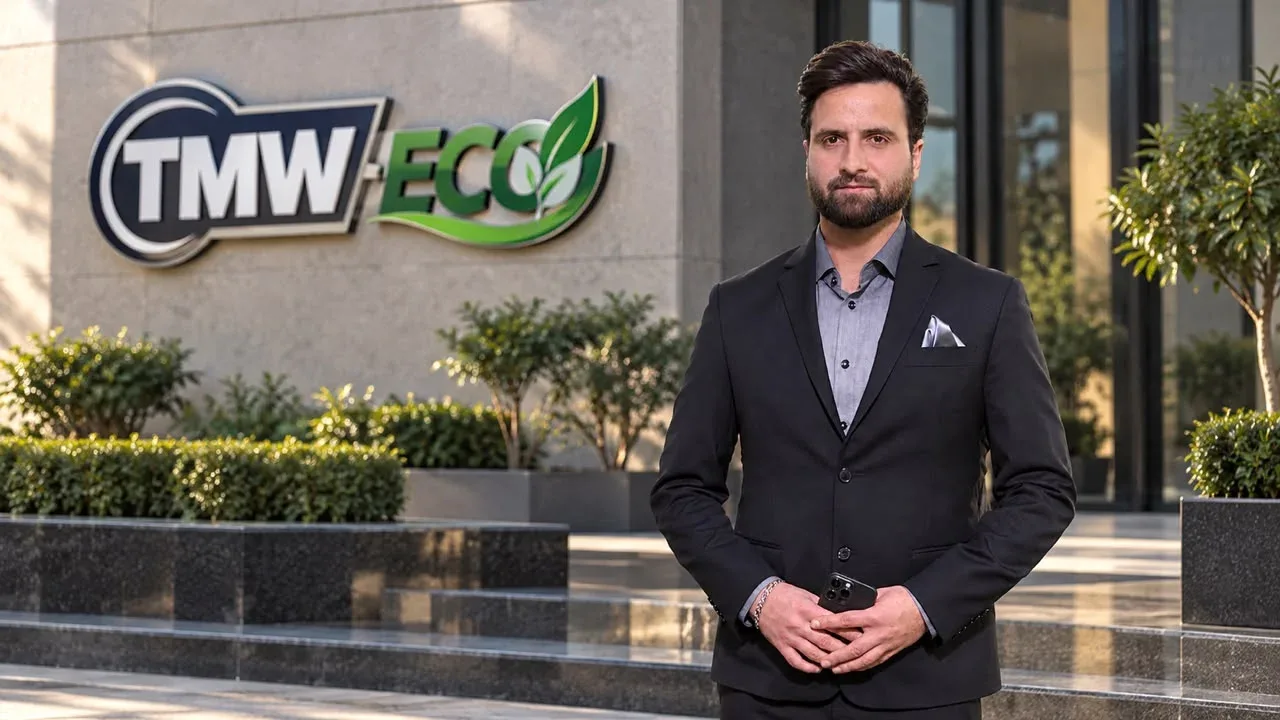
After more than two decades in the chemical fertilizer trade, Tahir Maqsood Wani says the next chapter of Kashmir’s farming must focus on feeding the soil, not just the crop.
By Tahir Maqsood Wani, Managing Director, TMW Group | TMW Eco Organic & Bio Fertilizers
KASHMIR – Organic farming in Kashmir is gaining a new advocate from an unexpected place: the fertilizer trade itself. Tahir Maqsood Wani began as a fertilizer dealer in a business that had served Kashmiri farmers for generations. What he saw in the fields convinced him that the future of agriculture cannot rest only on feeding crops. It must also focus on restoring the soil that sustains them.
From Urea and DAP to a Question About Soil
Wani’s family has been part of the chemical fertilizer trade since 1998. Through their joint family business, they have served farmers across Jammu and Kashmir as channel partners for leading fertilizer companies, including IFFCO, IPL, NFL, Chambal Fertilizers and KRIBHCO. Fertilizer depots, transportation, seasonal demand, urea and DAP were all part of everyday work.
Years of working closely with the sector also brought a growing concern. In farming areas including Shopian, Sopore and Baramulla, Wani saw rising dependence on agricultural inputs. Farmers worked hard to maintain productivity, yet questions about soil health, rising cultivation costs and long-term sustainability were becoming harder to ignore.
“Could we keep supporting farmers without giving equal attention to their soil health?” he recalls asking himself. That question became the foundation of his journey towards organic agriculture.
2017: A Shift to Biofertilizers and Organic Manure
In 2017, when he formally joined the family business, Wani chose a different path. Rather than focusing on the chemical fertilizer trade, he turned to biofertilizers and organic manure. The family set up a small manufacturing unit in Jammu and Kashmir to process organic waste and develop biofertilizer products.
The early years were about learning and experimenting with decomposition, organic waste management and quality control. Farmers also began showing interest in organic alternatives, which encouraged the team to keep improving its products and processes.
Challenges followed. Regulatory hurdles and market pressures made it increasingly difficult to operate the Kashmir unit, and the plant was eventually moved to Ludhiana, Punjab. The organic manure business continued to develop there for about three to four years, a period Wani describes as an important chapter for TMW Eco Organic.
How Paddy Straw Becomes Vermicompost
The Punjab years taught the team that agricultural waste need not be a problem. With proper processing it can become a resource for soil health. The work focused on biodegradable waste, particularly paddy straw, along with cow dung and other farm residues. Straw that might otherwise be burnt can be turned into useful organic material.
The vermicompost process runs through carefully managed stages:
- Segregation and pre-decomposition: collected waste is sorted and left for about 15 to 20 days so the initial heat subsides.
- Bed preparation: the material is placed in beds at roughly 60 to 70 percent moisture, and earthworms, primarily Eisenia fetida, are introduced.
- Maintenance: for the next 45 to 60 days, moisture, temperature and aeration are monitored while the worms produce fine, dark compost.
- Finishing: the compost is separated from the worms, sieved and prepared for packing.
Properly processed vermicompost supports beneficial microbial activity, improves soil structure and improves moisture retention. Today, TMW SoilCare is produced through the company’s own operations and supplied by trusted partner farms in Ambala and Karnal, Haryana. Each lot is checked for proper decomposition, sieving, an earthy smell, and the absence of raw material and contamination. The name, Wani says, reflects a simple principle: healthy crops begin with healthy soil.
A Growing Range: SoilPhos, TMW Potash and TMW FOM
TMW SoilPhos is a Phosphate Rich Organic Manure (PROM) made by co-composting rock phosphate with organic matter and enriching it with phosphate-solubilizing bacteria. It is designed to make phosphorus more available to plants through biological processes, as an organic option within an integrated nutrient-management program.
TMW Potash is derived from molasses through fermentation and concentration. It supports potassium nutrition, an important factor in fruit development, quality and crop performance. Suitability and application rates depend on the product specification, crop requirements and soil conditions.
TMW FOM (Fermented Organic Manure) is the company’s newest product for Kashmir and comes in three forms. Granules suit orchards and other cultivated fields. Powder can be used in paddy fields, saffron beds and vegetable plots, depending on the crop and recommended method. The liquid form suits suitable application systems, subject to the product label and technical guidance. Users should always follow the product’s specifications and instructions.
Ladakh: Free Organic Inputs to Test What Works
Ladakh holds a special place in the company’s journey. TMW supplied vermicompost and other organic products free of cost so farmers could try organic alternatives without the burden of upfront purchase. The aim was to show that organic inputs can work even in a challenging, high-altitude environment, and to let farmers judge them in their own fields.
Wani credits farmers, local institutions and the administration for progress on organic farming in Ladakh, and says the company is proud to have helped introduce organic products. The experience strengthened his belief in organic agriculture and motivated the company to focus on Kashmir.
Why Kashmir’s Apples, Saffron and Paddy Need Healthy Soil
Kashmir’s farming landscape ranges from apple orchards in Shopian, Sopore and Baramulla to saffron fields in Pampore, paddy, walnut and cherry orchards, and vegetable farms. All of it depends on the productivity of the land.
Soil, Wani points out, is a living system that supports roots, stores water, cycles nutrients and sustains beneficial organisms. When organic matter declines or soil structure deteriorates, farmers can face problems with water infiltration, aeration and root development. Overdependence on specific fertilizers and imbalanced nutrient application can add to long-term challenges.
“We must also ask what our farming practices are doing to the soil over the next ten or twenty years,” he says, instead of only asking how much fertilizer a crop needs in one season. Organic matter can improve soil structure and water-holding capacity, and integrated nutrient management guided by soil testing and crop requirements can balance immediate productivity with long-term soil health.
The environment is part of the picture as well. Agricultural runoff can carry nutrients and other substances into streams, rivers and lakes, and responsible fertilizer use, better soil management and suitable organic inputs can reduce avoidable losses and help protect water resources including the Jhelum and Dal Lake.
Wani stresses that the transition must be practical. Farmers cannot be expected to overhaul their systems overnight or risk their livelihoods without guidance. Organic inputs should be introduced based on crop requirements, soil conditions and agronomic advice, and any cut in chemical fertilizer should be planned carefully with monitoring of crop nutrition and yields. The goal, he says, is a more balanced, resilient and sustainable agricultural system, not simply swapping one product for another.
A Responsibility to the Next Generation
Wani says choosing organic agriculture in 2017 did not mean walking away from the responsibility his family has carried since 1998. “I chose to approach it differently,” he says. The mission of TMW Eco Organic is to help farmers understand the value of organic matter, explore suitable organic and biofertilizer products, and pay closer attention to the soil beneath their crops.
He is candid that lasting change takes time and needs reliable products, transparent quality standards, farmer education, scientific guidance and cooperation among farmers, researchers, institutions, businesses and policymakers. The company does not claim that one product can solve every agricultural challenge.
“We have spent generations feeding crops. It is time we gave equal attention to feeding the soil,” Wani says. Investing in soil today, he adds, gives future generations a better chance of inheriting productive farms, cleaner water and a healthier agricultural environment.
For more on the company and its organic and biofertilizer range, visit TMW Eco Organic & Bio Fertilizers.